Because the Lewis and Clark National Historic Trail spans nearly 4,900 miles across 16 states, there isn't just one single center. Instead, there is a large network of sites managed by federal, state, and local agencies.
According to the National Park Service, there are over 100 visitor centers and museums along the trail that specifically interpret the story of the Corps of Discovery.
While many small museums exist, a few are considered major hubs because of their size and the depth of their exhibits:
The trail is officially divided into segments, each with its own cluster of historical centers:
| Region | Key States | Notable Centers |
|---|---|---|
| Eastern Legacy | PA, WV, OH, KY, IN | Falls of the Ohio State Park, Indiana |
| Plains & Prairies | MO, KS, NE, IA | Sioux City Lewis and Clark Interpretive Center, Iowa |
| Missouri River | SD, ND | Akta Lakota Museum & Cultural Center, South Dakota |
| The Mountains | MT, ID | Sacajawea Heritage Center, Idaho |
| The Columbia | WA, OR | Fort Clatsop, Lewis and Clark National Historical Park, Oregon |
Most of these centers are free to visit or covered by the National Park Service's Interagency Pass. They provide a grounded look at the expedition's interactions with Indigenous tribes, their botanical discoveries, and the physical challenges of the trek.
Native Americans viewed hunting the grizzly bear as an undertaking akin to entering a battle. Before setting out, warriors would paint themselves and perform the same superstitious rites they used when preparing to make war on a neighboring nation [1-3]. Because they were armed primarily with bows and arrows or inferior, underpowered muskets acquired from traders, they were forced to get extremely close to the massive predators to land a fatal strike to the head or heart [1-3]. Due to this extreme danger, they never attacked a grizzly alone, instead hunting in large parties of six to ten men [1-3]. Even with these numbers, the encounters were highly perilous, and hunters were frequently killed or injured if they missed their mark [1, 2]. In some areas, Native Americans preferred to pursue the bear on horseback across the open plains to shoot it with arrows [4].
The explorers, on the other hand, relied on the superior firepower and accuracy of their rifles. Captain Meriwether Lewis initially believed that in the hands of skilled riflemen, grizzlies were not as formidable as Native Americans claimed [5]. Therefore, the explorers hunted the bears in much smaller numbers, going out alone, in pairs, or in small squads of up to six men [6-8]. When hunting in a group, the explorers used coordinated military-style tactics, where some men would fire at the bear while others reserved their loaded weapons to defend the group if the enraged animal charged [6, 9].
However, the explorers' methods had to quickly evolve. They discovered that grizzlies were astonishingly resilient, often ferociously pursuing the men even after taking multiple rifle balls directly to the lungs [9-11]. Lewis realized that the only way to bring down a grizzly with a single shot was to shoot it directly through the brain [12]. After several terrifying close calls, the captains adjusted their methods: Lewis resolved to primarily act on the defensive rather than actively hunting the bears, especially on the open plains, and Clark began dispatching his hunters in pairs rather than alone [8, 13].
Yes, the Spanish government launched four separate military missions with orders to intercept and arrest the Lewis and Clark expedition [1, 2].
Because Spain heavily contested the boundaries of the Louisiana Purchase, Spanish officials felt justified in seizing Captain Meriwether Lewis and his papers to crush American expansion before it could truly begin [1]. These efforts were actually spurred on by America's highest-ranking general, James Wilkinson, who was secretly acting as a double agent for Spain under the code name "Agent 13" [3]. Wilkinson personally urged the Spanish to deploy cavalry to hunt the expedition down [3].
The four attempts unfolded as follows:
In the late summer of 1804, two veteran travelers named Pedro Vial and José Jarvet led a column of more than fifty Spanish soldiers from Santa Fe to a Pawnee town on the Platte River [4]. Although they made incredible time covering over 800 miles and were shockingly close to intercepting the Americans, they inexplicably rested for two weeks and then just headed back to Santa Fe [4, 5].
Late in the summer of 1805, Spain sent Vial and Jarvet out again, this time with more than a hundred soldiers [6, 7]. Their orders were to persuade Native leaders to "intercept" the Americans on their return trip and seize their papers [7]. However, about 300 miles into the journey, the Spanish column was ambushed in the night by a heavily armed group of Native Americans who stole their supplies, forcing Vial and Jarvet to retreat once more [7, 8].
In the spring of 1806, Vial and Jarvet tried for a third time, but the mission was a disaster because their men quickly deserted [9].
In June 1806, the Spanish dispatched a massive force of more than six hundred dragoons, militiamen, and Native allies under the command of Facundo Melgares [9]. The troops struggled to find food, and two hundred starving men signed a petition asking to go home [10]. Melgares responded by stripping and beating the first soldier who had signed the petition, threatening to hang anyone else who complained [10]. Ultimately, this massive army also failed to catch the Corps of Discovery [11].
Native Americans viewed hunting the grizzly bear as an undertaking akin to entering a battle. Before setting out, warriors would paint themselves and perform the same superstitious rites they used when preparing to make war on a neighboring nation [1-3]. Because they were armed primarily with bows and arrows or inferior, underpowered muskets acquired from traders, they were forced to get extremely close to the massive predators to land a fatal strike to the head or heart [1-3]. Due to this extreme danger, they never attacked a grizzly alone, instead hunting in large parties of six to ten men [1-3]. Even with these numbers, the encounters were highly perilous, and hunters were frequently killed or injured if they missed their mark [1, 2]. In some areas, Native Americans preferred to pursue the bear on horseback across the open plains to shoot it with arrows [4].
The explorers, on the other hand, relied on the superior firepower and accuracy of their rifles. Captain Meriwether Lewis initially believed that in the hands of skilled riflemen, grizzlies were not as formidable as Native Americans claimed [5]. Therefore, the explorers hunted the bears in much smaller numbers, going out alone, in pairs, or in small squads of up to six men [6-8]. When hunting in a group, the explorers used coordinated military-style tactics, where some men would fire at the bear while others reserved their loaded weapons to defend the group if the enraged animal charged [6, 9].
However, the explorers' methods had to quickly evolve. They discovered that grizzlies were astonishingly resilient, often ferociously pursuing the men even after taking multiple rifle balls directly to the lungs [9-11]. Lewis realized that the only way to bring down a grizzly with a single shot was to shoot it directly through the brain [12]. After several terrifying close calls, the captains adjusted their methods: Lewis resolved to primarily act on the defensive rather than actively hunting the bears, especially on the open plains, and Clark began dispatching his hunters in pairs rather than alone [8, 13].
Yes, the explorers strongly hoped and expected to encounter a ship when they reached the Pacific coast.
Their expectations were driven by several major needs and instructions:
By the time they reached the ocean, the expedition had almost entirely run out of merchandise and trinkets. They desperately hoped to meet trading ships so they could acquire more goods, which they needed to barter with Native Americans for food and horses on their return journey across the continent [1, 2].
President Jefferson had explicitly instructed Captain Lewis to look for ships so they could send two trusted people back by sea with copies of their notes. This would ensure the expedition's findings would survive even if the main party perished on the overland journey home [2, 3].
Jefferson's instructions actually gave the captains permission to ship the entire party back by sea (via Cape Horn or the Cape of Good Hope) if they determined that returning by land would be too dangerous [3].
Unfortunately, no ship ever appeared. The expedition spent the rainy winter at Fort Clatsop waiting and hoping that a trading vessel or a boat sent by President Jefferson would arrive, but none did [1, 4, 5]. Captain Lewis noted in his journal that meeting with traders was the only goal they failed to accomplish during their stay at the fort [4].
One source notes that it is actually quite strange that Jefferson didn't organize a specific relief ship to meet them at the mouth of the Columbia River, which would have saved the explorers a world of worry and discomfort. However, the president likely avoided sending a ship because he did not want to rouse the suspicion or animosity of the European nations that held possessions on the Pacific coast at that time [1].
Yes, the expedition did eat dogs while wintering at Fort Clatsop.
The local Clatsop chief, Comowool (also known as Coboway), noticed that the soldiers ate dog meat. Although this practice revolted the Clatsop people, Coboway accommodated his customers and began bringing dogs to the fort to trade [1]. For instance, on January 3, he visited the Americans and sold them three dogs along with roots, berries, and fresh whale blubber [2].
Although the explorers had originally felt a strong aversion to eating dog, necessity and habit had completely overcome their reluctance, and a majority of the men acquired a fondness for the meat [2]. In their journals, they reflected that while subsisting on dog flesh, they were fatter, stronger, and enjoyed generally better health than at any period since they had left the buffalo country east of the mountains [2].
In fact, dog meat became a staple for the party even after leaving Fort Clatsop; Captain Lewis noted that it had become a "favorite food" that provided a healthy, strong diet, and he personally preferred it over lean venison, elk, or horse meat [3].
Yes, Native American tribes provided essential aid to the Lewis and Clark expedition throughout almost the entire journey. The expedition relied on a "chain of friendship" spanning from the Mandan villages across the Bitterroot Mountains to the Pacific coast, and without the food, shelter, and guidance of these Native communities, the explorers likely would not have succeeded or even survived [1].
Whenever the expedition faced starvation or lacked supplies, Native nations routinely fed them:
During their first winter, the Mandans and Arikaras supplied the expedition with crucial crops like corn, beans, and squash [2-4].
When the explorers emerged starving and exhausted from the freezing Bitterroot Mountains, an elderly Nez Perce (Chopunnish) woman named Watkuweis urged her people to do them no harm; as a result, the Nez Perce warmly welcomed them and fed them camas roots and dried salmon [5, 6].
The Nez Perce were remarkably hospitable, later offering the explorers as many fat young horses as they wanted to eat when the white men were out of meat [7, 8].
Along the Columbia River and near the Pacific Ocean, tribes such as the Clatsops and Walla Wallas sustained the expedition with fish, wapato roots, berries, and even stranded whale blubber [9-12].
Because the Rocky Mountains were impassable by water, the expedition desperately needed pack animals to continue their journey westward.
The Shoshone and Flathead nations traded the explorers the horses they needed to transport their baggage over the treacherous mountain passes [13-16].
The Nez Perce taught the explorers an efficient Indian method for building dugout canoes by burning out the hollows of the logs rather than just hacking at them [17, 18].
Furthermore, the Nez Perce faithfully watched over the expedition's thirty-eight horses for months while the explorers traveled down the river to spend the winter on the Pacific coast, returning the herd to them in the spring [17, 19].
Native Americans constantly acted as guides and mapmakers, steering the expedition through a confusing and unmapped wilderness:
A Shoshone man known to the explorers as Old Toby guided Captain Clark through the difficult mountain terrain [20, 21].
Nez Perce chiefs like Twisted Hair and Tetoharsky accompanied the expedition down the Snake and Columbia rivers, helping them navigate the rapids and acting as ambassadors to assure other villages that the white men were friendly [22].
During the return trip, expert Nez Perce guides successfully navigated the expedition back over the snow-covered Bitterroot Mountains; Captain Clark noted that without them, they would never have found their way [23, 24].
Throughout the journey, various Native leaders provided vital intelligence by drawing maps on hides or in the dirt to show the explorers the courses of rivers, the locations of mountain passes, and the fastest shortcuts [25-27].
While the expedition did experience moments of tension, theft, and hostility—most notably with the Teton Sioux and a violent clash with the Blackfoot [28, 29]—the explorers were fundamentally dependent on the generosity and hospitality of the Native American tribes they encountered along the way [1].
You are thinking of York and Sacajawea, who were the notable exceptions during this bout of illness. Captain Clark actually did get sick, and he may have been the very first one to do so.
Here is how the events unfolded:
Clark was leading an advance party and was the first to reach the Nez Perce, who fed him camas roots and dried salmon. Because his digestive system was not accustomed to the food, he became severely ill and noted in his journal, "I am very sick today and puke, which relieves me" [1, 2].
A couple of days later, Clark reunited with Captain Lewis and the rest of the starving expedition. He found them eagerly gorging themselves on the roots and fish. Having already experienced the painful consequences, Clark "cautioned them of the consequences of eating too much," but the starving men ate heartily anyway and became violently ill [3]. Even as he watched his men fall incapacitated alongside the road, Clark admitted that he was still "a little unwell" himself [4].
The two members of the expedition who were spared this severe gastrointestinal shock were York and Sacajawea:
York: The expedition journals do not record York as getting sick during this crisis [5]. He possessed an incredibly sturdy constitution and stayed busy making soup and nursing Lewis and the other incapacitated men back to health [5].
Sacajawea: While the camas root was a completely foreign food to the white explorers, it was not new to Sacajawea [6]. The Shoshone regularly ate camas (which they called pasigo), so her body was already well-adapted to the diet and she relished her portion [6]. Furthermore, during the preceding weeks of starvation in the Bitterroot Mountains, Sacajawea had refused to eat the expedition's slaughtered horses because it was taboo for her people; she and her baby had survived instead on portable soup, flour, and provisions she had saved [7].
You are thinking of York and Sacajawea, who were the notable exceptions during this bout of illness. Captain Clark actually did get sick, and he may have been the very first one to do so.
Here is how the events unfolded:
Clark was leading an advance party and was the first to reach the Nez Perce, who fed him camas roots and dried salmon. Because his digestive system was not accustomed to the food, he became severely ill and noted in his journal, "I am very sick today and puke, which relieves me" [1, 2].
A couple of days later, Clark reunited with Captain Lewis and the rest of the starving expedition. He found them eagerly gorging themselves on the roots and fish. Having already experienced the painful consequences, Clark "cautioned them of the consequences of eating too much," but the starving men ate heartily anyway and became violently ill [3]. Even as he watched his men fall incapacitated alongside the road, Clark admitted that he was still "a little unwell" himself [4].
The two members of the expedition who were spared this severe gastrointestinal shock were York and Sacajawea:
York: The expedition journals do not record York as getting sick during this crisis [5]. He possessed an incredibly sturdy constitution and stayed busy making soup and nursing Lewis and the other incapacitated men back to health [5].
Sacajawea: While the camas root was a completely foreign food to the white explorers, it was not new to Sacajawea [6]. The Shoshone regularly ate camas (which they called pasigo), so her body was already well-adapted to the diet and she relished her portion [6]. Furthermore, during the preceding weeks of starvation in the Bitterroot Mountains, Sacajawea had refused to eat the expedition's slaughtered horses because it was taboo for her people; she and her baby had survived instead on portable soup, flour, and provisions she had saved [7].
Yes, the men of the expedition suffered from severe gastrointestinal illness—including diarrhea (dysentery), stomach cramps, and nausea—after gorging themselves on camas roots and dried salmon provided by the Nez Perce (Chopunnish) in Idaho [1, 2].
After enduring near-starvation and a diet of horsemeat while crossing the Bitterroot Mountains, the explorers arrived at the Nez Perce villages and eagerly feasted on the new food [2, 3]. The camas root (also called quamash or pasheco) was served to them raw, boiled into soup, or made into cakes [4].
This sudden, drastic change in their diet shocked their systems, and bacteria on the dried salmon may have also contributed to the illness [5]. The consequences were debilitating:
Captain Clark became very sick and vomited, noting that they had "nothing to eat but roots, which give the men violent pains in their bowels" [5, 6].
Captain Lewis became so weak and ill that he could scarcely sit on his horse [2, 3].
Several of the men suffered from such extreme weakness and pain that they were forced to lie down alongside the road [3].
The illness incapacitated the camp for several days [1, 5]. The situation was only made worse by Captain Clark's preferred medical treatment; he administered laxatives (such as Rush's pills and salts) to men who were already suffering from severe diarrhea, which only exacerbated their condition [5, 7].
Yes, the expedition was forced to kill and eat horses to survive while crossing the deep snows of the Bitterroot Mountains.
As they struggled through the freezing, snow-packed passes and found no game to hunt, the men faced severe starvation [1]. To stay alive, they resorted to killing three of their own colts over the course of several days [2].
When they killed the first colt out of desperation for meat, they named the nearby stream "Colt Killed Creek" [3, 4].
A few days later, cold, wet, and hungry, they killed a second colt, which they "supped heartily on and thought it fine meat" [5].
They eventually killed a third colt because it was "the most useless part of our stock" and they remained desperate for food [2, 6].
In addition to their own pack animals, Captain Clark's advance party stumbled upon a stray wild horse in a glade near Hungry Creek. The men begged to kill it for food, and Clark gave them permission to shoot and eat it, leaving the remainder of the carcass hanging in a tree for Lewis's group following behind them [7, 8].
Interestingly, while the starving men eagerly ate the horse meat, Sacajawea likely refused to eat it, as consuming horse flesh was taboo among her people, the Shoshone [9]. While the soldiers dined on the colts, she and her baby survived instead on portable soup, flour, and provisions she had managed to forage and save [2, 9].
The journals of the Lewis and Clark expedition are filled with profoundly human moments of connection, grief, and shared vulnerability.
When the expedition reached the Shoshone camp, Sacajawea had an incredibly moving reunion with her childhood friend, Leaping Fish, who had also been captured by the Minnetarees years earlier [1-3]. They held each other tightly and cried softly, having never expected to see one another again [3]. Shortly after, when Sacajawea was called to interpret for the captains, she recognized the Shoshone chief Cameahwait as her own brother [4, 5]. She ran to him, embraced him, threw her blanket over him, and wept so profusely that she was initially unable to interpret [4-6].
Sacajawea consistently shared what little she had to comfort others [7, 8]. When she finally reunited with Cameahwait, she gave him a sugar lump she had been saving for her baby, Pompey, giving the chief his first taste of sugar [7, 9]. Later, when the crew was suffering from a diet of dried fish and roots on the Columbia Plateau, Captain Clark became so ill he could not eat [8]. Sacajawea gave him a small piece of bread she had carried all the way from Fort Mandan; though it had soured from the wet conditions, she decided Clark needed it more than her baby, and the bread deeply heartened the ailing captain [8].
Meriwether Lewis demonstrated deep affection for his Newfoundland dog, Seaman [10, 11]. When a beaver bit Seaman and severed an artery in his hind leg, Lewis held the howling dog down and pressed a cloth against the wound with great difficulty to stop the bleeding and save his life [11-13]. Lewis also showed kindness to a sick Nez Perce guide by giving the man his own buffalo robe to keep warm in the freezing mountains [14].
Captain Clark demonstrated consistent empathy through his medical care for both his men and the Native Americans they encountered, driven by a deep-seated hatred of seeing people suffer from their wounds or illnesses [15]. He was especially tender toward Sacajawea's baby, Pompey, whom he affectionately called "my little dancing boy" [16, 17]. When the expedition heard of a beached whale on the Pacific coast, Clark ensured Sacajawea was allowed to accompany the party to see it, honoring her heartfelt plea that after traveling so far, it would be "very hard" if she could not see the ocean and the "monstrous fish" [18, 19]. When a Sioux woman gave birth early in the expedition, Clark wrapped the infant in an expedition flag and affectionately declared the baby "a true American citizen" [20].
York, Clark's enslaved body servant, provided tender care for Clark when the captain suffered from violent stomach and bowel pain on the Ohio River, sitting beside his sick owner and feeding him soup [21]. Sergeant John Ordway showed unique emotional intelligence regarding Sacajawea; while Lewis coldly assumed she felt no emotion upon reaching the site of her childhood capture at Three Forks, Ordway worried about her and tried to understand the depth of her feelings [22-24]. Ordway also took the time to speak with Native women who were wailing in a village, using sign language to learn they were grieving sons lost in battle, a sentiment that resonated deeply with him [25].
The journals record striking moments of Native compassion [26, 27]. During a bitter winter at Fort Mandan, a thirteen-year-old boy of "no distinction" was left out in the snow, yet the entire village was full of anxiety for his safety and rushed out with a borrowed sleigh to save him [26].
Perhaps the most consequential act of empathy came from Watkuweis, an elderly Nez Perce woman [27, 28]. When some of her people wanted to kill the starving, weakened explorers, she pleaded for their lives because white traders had been kind to her when she was a captive years earlier [27, 28]. She told her people, "These are the people who helped me. Do them no harm" [28].
During the expedition's stay with the Arikara nation in October 1804, York entertained the many families and children who gathered to see him [1, 2]. Using a translator, York told the children silly stories, claiming that he had grown up as a wild bear, or a wild animal that had been caught and tamed by his master [2-4]. He playfully joked that he still liked to eat people and that small people were the tastiest of all [2].
As part of his routine, York would let the children sneak up on him before suddenly spinning around and pretending to roar [5]. The children absolutely loved the game; they would run away and "holler" as if they were terrified, only to flock right back to him [2, 5]. He also performed impressive feats of strength to "convince" his audience of his wild nature [3, 4]. While the children were delighted, Captain William Clark was irritated by the act, complaining in his journal that York "made himself more terrible in their view than I wished him to do" [2-4].
This information comes from three of your provided sources:
A New History of Lewis & Clark.pdf": This text details York's specific routine of roaring at the children, his joke about eating small people, and quotes Sergeant John Ordway's journal about how the children reacted [2, 5].
"The Journals of Lewis and Clark (National Geographic Adventure Classics).pdf": This source includes a note added by Nicholas Biddle describing how York amused the Native Americans by telling them he was a tamed wild animal and showing off his strength [4].
"First Across the Continent The story of the exploring expedition of Lewis and Clark in 1804-5-6.pdf": This source also quotes the expedition journals regarding York's claim of being a wild animal caught by his master [3].
York, who was Captain William Clark's enslaved body servant, grew up alongside Clark and transitioned during the expedition from a traditional servant into an indispensable, fully participating member of the Corps of Discovery [1, 2]. His highlights on the journey encompass grueling physical labor, crucial roles in survival, and unique diplomatic interactions:
A man of immense strength and "very large size," York performed heavy manual labor throughout the journey, from using a whipsaw to cut planks for their first winter camp to hoisting sixteen-foot beams to build Fort Mandan [3-6]. As an excellent swimmer and elite riverman, York was specifically trusted by Clark to help steer and paddle their fragile canoes through the terrifying, boiling rapids of the Clearwater, Snake, and Columbia rivers [7-9].
Unlike most enslaved people of the era, York was allowed to carry a rifle [10]. He was an excellent shot and made history on September 9, 1804, when he became the fifth named member of the expedition to kill a buffalo [11, 12]. He also acted as the primary cook for the captains, foraging for wild greens and preparing meals like fried salmon in bear oil [13, 14].
Native nations across the continent had never seen a Black man before and were absolutely fascinated by him, frequently checking to see if his dark skin color would wipe off [15-18]. Believing he possessed immense spiritual power, Native women sometimes shared their beds with him hoping to acquire that power for their people [19-21].
York leaned into the attention, entertaining Native hosts with his dancing, agility, and feats of strength, such as easily pressing two eighty-pound kegs of salt pork above his head [16, 22, 23]. He frequently played with Native children, telling them stories that he had once been a wild bear, roaring and playfully chasing them—a routine the children adored, even though Clark complained that York made himself seem too terrible [24-26].
Over the course of the grueling journey, York earned the deep respect of the soldiers and took on responsibilities rarely afforded to enslaved men, such as being trusted to stand guard as a sentry at Fort Clatsop [27]. Perhaps the greatest highlight of his participation occurred on November 24, 1805, when the Corps needed to decide where to build their winter quarters on the Pacific coast. The captains put the decision to a vote and included York, polling his opinion and counting his vote alongside the white soldiers and Sacajawea [28-30].
After the expedition ended, York asked for his freedom as a reward for his immense services, but William Clark refused [1, 2]. When York became angry, heartbroken, and resistant to this denial, Clark initially planned to have him "punished," though Meriwether Lewis temporarily talked him out of it [2-4].
However, their relationship continued to deteriorate, and in the spring of 1809, Clark gave York what he described in a letter as "a severe trouncing" [5, 6]. Furthermore, in the summer of that same year, York ended up in prison, which was likely Clark's doing [5]. Clark did not officially free York until around 1820, more than a decade after the expedition had concluded [7].
After the expedition ended, York asked for his freedom as a reward for his immense services, but William Clark refused [1, 2]. When York became angry, heartbroken, and resistant to this denial, Clark initially planned to have him "punished," though Meriwether Lewis temporarily talked him out of it [2-4].
However, their relationship continued to deteriorate, and in the spring of 1809, Clark gave York what he described in a letter as "a severe trouncing" [5, 6]. Furthermore, in the summer of that same year, York ended up in prison, which was likely Clark's doing [5]. Clark did not officially free York until around 1820, more than a decade after the expedition had concluded [7].
The members of the Lewis and Clark expedition had vastly different lifespans following their return to civilization in September 1806. (It is worth noting that one member, Sergeant Charles Floyd, never finished the journey, having died of a ruptured appendix in August 1804 [1]).
By 1828, William Clark took stock of the original 32 members of the expedition. At that time, 7 had been killed in frontier skirmishes, 10 had died of various other causes, the whereabouts of 5 were unknown, and 10 were known to still be living [2].
Here is how long some of the notable members lived after the journey ended:
The Captains
He lived for more than three decades after the expedition, serving as the governor of Missouri and Superintendent of Indian Affairs, before dying on September 1, 1838 [1, 3].
Tragically, Lewis died just three years after returning. He suffered from severe depression and died on October 11, 1809, in an incident generally believed to be suicide [4-6].
The Longest Livers
He lived the longest of any of the men, surviving until April 1870, when he died at the age of 98 [1].
He also lived a remarkably long life, moving to California in his later years and passing away in 1865 [7].
The infant who traveled with the expedition grew up to travel Europe, become a fur dealer, and serve as a guide. He died in 1866 at the age of 61 while searching for gold in Oregon [8, 9].
Several members returned to the dangerous wilderness as trappers and were killed in conflicts with Native nations:
George Drouillard and John Potts were both killed by Blackfoot Indians in 1810, near the Three Forks of the Missouri [7, 10, 11].
John Collins was killed in a battle with the Arikara in 1823 [12].
Other Notable Members
John Shields and George Gibson both died shortly after the expedition, in 1809 [7, 12].
John Colter survived his legendary escapes from the Blackfoot but died of a sudden illness (likely jaundice) in either 1812 or 1813 [12, 13].
John Ordway returned to his home, eventually moved west again, and died in 1817 [1, 14].
Nathaniel Pryor stayed in the army, entered the fur trade, married an Osage woman, and died in 1831 [1].
William Bratton served in the War of 1812, fathered ten children, and died in 1841 [12].
Toussaint Charbonneau lived a long life; he was last heard from in 1839 when he was around 80 years old, asking for back pay as an interpreter in St. Louis [9].
Sacagawea is widely believed by historians to have died of a "putrid fever" on December 20, 1812, a little over six years after the expedition ended, although some unverified stories suggest she returned to her people and lived to be nearly 100 [15].
York, whom Clark refused to free and kept enslaved for more than a decade after the expedition, was finally freed around 1820. He became a wagon driver and died of cholera a few years later [16, 17].
Yes, devastating epidemics, particularly smallpox, had already swept through the Missouri River valley and severely decimated several Native nations long before Lewis and Clark arrived. Pathogens spread rapidly along the river through trade networks and war parties, creating a demographic vacuum in the region.
The journals and historical accounts note the catastrophic impact on several specific nations:
About four years before the expedition, the Omaha nation was devastated by smallpox, which swept away roughly 400 men, women, and children and reduced their fighting strength to no more than 300 men [1-3]. The frenzy and despair caused by the malady were so extreme that survivors burned their village, and some even put their own wives and children to death so that they could escape the suffering and all "go together to some better country" [1, 4]. The explorers visited the grave of their powerful king, Blackbird, who had also died of smallpox during this outbreak [5, 6].
Disease hit dense agricultural communities particularly hard, killing people faster than they could be buried [7]. The Arikara lost an estimated 80 percent of their population to epidemics [7]. When the Arikara leader Piahito was a boy, his nation boasted thirty or more towns; by the time Lewis and Clark arrived, this number had been reduced to just three, forcing refugees from various decimated bands to consolidate together for protection [8, 9].
Like the Arikara, the Mandan lost perhaps 80 percent of their population to the smallpox epidemics [7]. As the Corps of Discovery traveled up the Missouri, they frequently passed the ruins of abandoned, overgrown Mandan towns—silent proof of how the disease and subsequent pressures from the Sioux had reduced their numbers [10-12].
The Lakota endured at least three devastating epidemics during this period [7]. Between 1780 and 1782, as many as one in six Lakota died, with one tribal winter count simply recording that smallpox "used them up" [7]. However, because they were more mobile hunters rather than living in dense agricultural towns, they were ultimately able to maintain their regional dominance over the harder-hit farming nations [7, 13].
Yes, devastating epidemics, particularly smallpox, had already swept through the Missouri River valley and severely decimated several Native nations long before Lewis and Clark arrived. Pathogens spread rapidly along the river through trade networks and war parties, creating a demographic vacuum in the region.
The journals and historical accounts note the catastrophic impact on several specific nations:
About four years before the expedition, the Omaha nation was devastated by smallpox, which swept away roughly 400 men, women, and children and reduced their fighting strength to no more than 300 men [1-3]. The frenzy and despair caused by the malady were so extreme that survivors burned their village, and some even put their own wives and children to death so that they could escape the suffering and all "go together to some better country" [1, 4]. The explorers visited the grave of their powerful king, Blackbird, who had also died of smallpox during this outbreak [5, 6].
Disease hit dense agricultural communities particularly hard, killing people faster than they could be buried [7]. The Arikara lost an estimated 80 percent of their population to epidemics [7]. When the Arikara leader Piahito was a boy, his nation boasted thirty or more towns; by the time Lewis and Clark arrived, this number had been reduced to just three, forcing refugees from various decimated bands to consolidate together for protection [8, 9].
Like the Arikara, the Mandan lost perhaps 80 percent of their population to the smallpox epidemics [7]. As the Corps of Discovery traveled up the Missouri, they frequently passed the ruins of abandoned, overgrown Mandan towns—silent proof of how the disease and subsequent pressures from the Sioux had reduced their numbers [10-12].
The Lakota endured at least three devastating epidemics during this period [7]. Between 1780 and 1782, as many as one in six Lakota died, with one tribal winter count simply recording that smallpox "used them up" [7]. However, because they were more mobile hunters rather than living in dense agricultural towns, they were ultimately able to maintain their regional dominance over the harder-hit farming nations [7, 13].
On July 26, 1806, during the expedition's return journey, Captain Meriwether Lewis was exploring the Marias River (specifically the Two Medicine River valley) with a small detachment of only three men: George Drouillard, Reuben Field, and Joseph Field [1-3]. Lewis spotted a group of eight Native Americans with a herd of about thirty horses and initially feared they were a hostile band of "Minitaris of Fort de Prairie" who might try to rob them [1, 4]. In reality, they were a party of Piikani (a band of the Blackfoot nation) horse raiders, which included a respected leader named Sidehill Calf and a teenager named Wolf Calf [5-8].
Lewis chose to approach the group in a friendly manner. He and Sidehill Calf shook hands, exchanged gifts, and agreed to camp together for the night in a river bottom [4, 9, 10]. Through Drouillard's sign language, Lewis told the Blackfoot that the United States now controlled the territory and urged them to make peace with their enemies, the Shoshone and the Salish, promising to supply those tribes with weapons for defense [11, 12]. This was a "geo-political bombshell" for the Blackfoot, whose dominance in the region relied heavily on keeping guns out of the hands of their enemies [8, 13]. Unbeknownst to Lewis, Sidehill Calf covertly instructed his men to steal the Americans' horses and guns the next morning [14, 15].
At dawn on July 27, the Blackfoot put their plan into action. Joseph Field, who was on guard duty, had carelessly laid his rifle on the ground [16, 17]. A Blackfoot man seized his gun, his brother Reuben's gun, and the weapons belonging to Lewis and Drouillard [16, 17]. Joseph yelled to his brother, and they chased the men who took their rifles. After wrestling the guns back, Reuben Field drew his knife and stabbed Sidehill Calf in the heart, killing him instantly [16-18].
The shouting awoke Lewis, who saw Drouillard wrestling for his gun and another Blackfoot man running away with his own [16, 19, 20]. Lewis drew a pistol, chased the man, and forced him to drop the rifle [16, 20].
Having failed to steal the weapons, the Blackfoot changed tactics and attempted to drive off all the horses, prompting Lewis to order his men to fire if necessary [16, 21, 22]. Lewis chased two of the Blackfoot into a steep niche in the bluffs [21, 23]. When they refused to return his horse, Lewis raised his gun and shot one of the men in the belly [21, 23]. The wounded man fell to his knees but managed to fire back; the bullet passed so close to Lewis's bare head that he distinctly felt the wind from it [21, 23].
Because Lewis had left his shot pouch at camp and could not reload his rifle, he retreated [21, 23, 24]. The Americans managed to catch four of their own horses and took four of the best Blackfoot horses, leaving behind a peace medal around the dead Sidehill Calf's neck to let the tribe know who they were [24-26].
Knowing the surviving Blackfoot would quickly alert a larger war party, Lewis and his men rode relentlessly for their lives [24, 27]. They covered about 100 miles before stopping at 2 a.m. to briefly rest [28-30]. The next morning, to their immense relief, they heard the sound of an American rifle and reunited with the rest of their party traveling safely down the Missouri River in canoes [31-33].
While many of the expedition's journals were carefully preserved, some of the journals were indeed lost forever, and others were only found after being missing for over a century.
The journal of Private Robert Frazer (or Frazier) has never been found, even though he had announced plans to publish a 400-page history of the expedition shortly after returning, and a map and proposal for his publication survived [1, 2].
The original manuscript of Sergeant Patrick Gass's journal has disappeared, although a heavily edited version of his travels was successfully published in 1807 [3].
Because all sergeants were required to keep diaries, Sergeant Nathaniel Pryor probably kept a journal, but it remains undiscovered [1, 2]. Private Alexander Hamilton Willard may also have kept a journal that is now lost [2].
There are also large gaps in Meriwether Lewis's daily entries—such as a long silence from November 1803 to April 1805—which has led some historians to suspect that some of his intervening journal notebooks may have been lost [4, 5].
The comprehensive journals of Sergeant John Ordway were lost for over 100 years before they were finally discovered and published in 1916 [6].
Parts of the expedition's journals and scientific records were indeed lost or delayed in their publication for many years. Originally, Meriwether Lewis intended to edit the diaries for publication, but he died in 1809 without having written a single word for the book [1, 2]. Following his death, William Clark hired a lawyer named Nicholas Biddle to complete the project, which resulted in a heavily edited two-volume history published in 1814 [3, 4]. In this 1814 edition, Biddle rewrote the original entries to normalize the erratic spelling and grammar, and he cut almost all of the scientific material from the publication [3, 4].
Because the scientific findings were sidelined, much of the expedition's raw data was neglected. Botanical specimens and notes that were entrusted to botanist Benjamin Barton were lost in a disorganized heap of papers upon his death in 1815, and they did not come to light again until 1896, when they were found among the holdings of the American Philosophical Society [5, 6]. Furthermore, the full, raw daily journal entries of the two captains were not published in their entirety until a scholarly edition edited by Reuben G. Thwaites was released between 1901 and 1904 [7].
Other personal accounts from the expedition were literally lost for over a century. Most notably, the journals of Sergeant John Ordway were lost for over 100 years and were not finally published until 1916 [8].
On their return trip from the Pacific, the expedition did not simply abandon their boats; instead, they either traded them away or deliberately destroyed them.
Navigating upstream against the Columbia River was much harder in the spring because the water was swollen with melting snow, making the rapid currents incredibly difficult and dangerous to pass [1]. Because of these treacherous conditions, the captains decided to purchase horses from the local Native American nations so they could travel the rest of the way to the mountains entirely by land [1, 2].
As they acquired enough horses to carry their baggage, they no longer needed their pirogues and canoes [3, 4]. The local Indians, seeing that the explorers were switching to land travel, refused to trade fairly for the watercraft, hoping that the expedition would be forced to abandon the boats so the locals could take them for free [4].
Disgusted by this behavior, the captains decided they would rather cut the boats to pieces than let the Native Americans enjoy them without paying [4]. In several instances, the men broke up their pirogues and canoes to use as much-needed firewood, doing so right in front of the locals to ensure not a single particle was left for their benefit [3, 5-7]. In one case, the men actually began splitting the canoes with axes, which finally prompted the Indians to offer a few strands of beads in exchange to save the remaining boats [4]. In the end, the remaining canoes were bartered away for beads [6, 8].
It is worth noting that once the expedition crossed the Rocky Mountains on horseback and returned to the Missouri River watershed, they dug up the original boats they had hidden (cached) the previous year [9, 10]. They successfully used the white pirogue and their small canoes for the rest of the journey downriver to St. Louis, but they were forced to abandon their red pirogue because it had decayed too much in the cache to be repaired [11].
The expedition cached their boats in several different locations within the Missouri River watershed as the waterways became progressively smaller and more difficult to navigate during their westward journey:
In order to lighten their loads before entering the mountains, the explorers left the red pirogue on a small island at the entrance of Maria's River [1-3]. The boat was drawn up onto the middle of the island and securely fastened to trees to protect it from floods [2]. Unfortunately, upon their return the following year, they found the red pirogue was too decayed to be repaired and were forced to leave it behind [4, 5].
Confronted with the massive waterfalls, the expedition was forced to make an eighteen-mile overland portage and could not transport their largest remaining boat [6, 7]. They drew the white pirogue ashore into a thick copse of willow bushes just below their camp at Portage Creek, removed its drain plugs, and covered it with brush and driftwood to protect it from the sun [8, 9].
As they pushed deep into the Rocky Mountains, the river became too shallow, rapid, and rocky to navigate [10, 11]. At the forks of the Jefferson River (also referred to as the forks of the Beaverhead), they hauled one canoe into the bushes [10] and sank the others into the river with rocks to conceal and preserve them until the return trip [11]. When Captain Clark's party returned to this cache the next year, they successfully raised and repaired these canoes to quickly travel back down the river [12, 13].
During his solo winter trek of 1807–1808, John Colter became the first non-native explorer to discover the geothermal wonders of the Yellowstone region [1, 2].
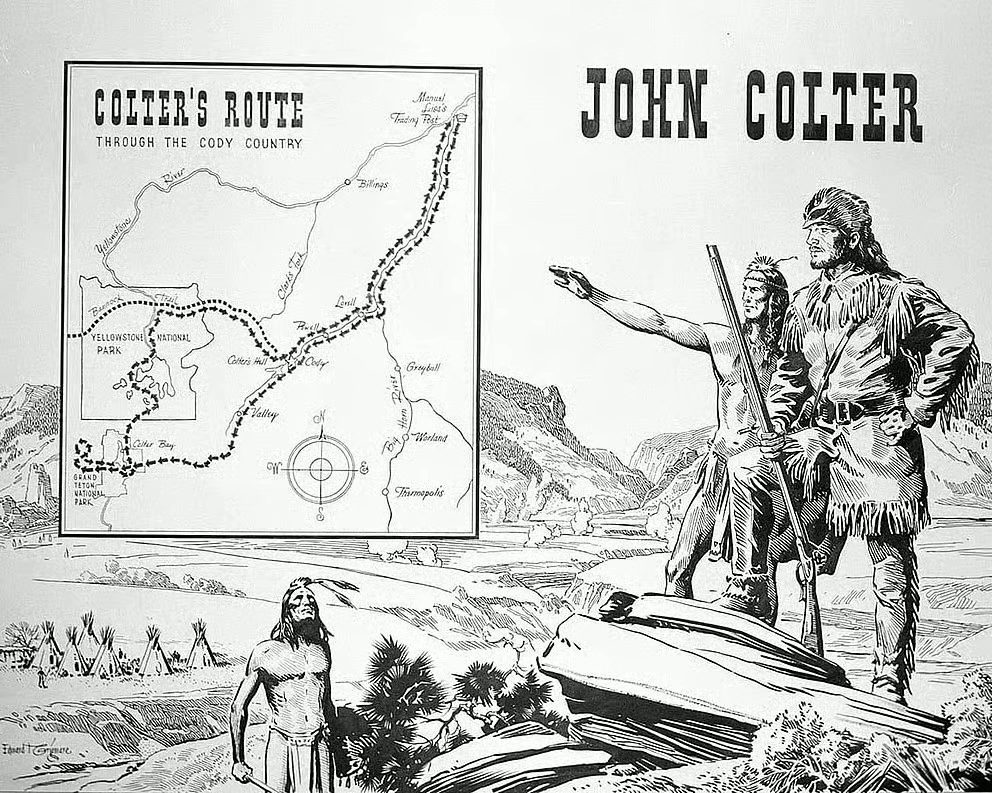
His initial encounter with these features occurred near the mouth of the Valley River along the Stinking Water River (present-day Shoshone River) [3]. After days in the fresh mountain air, Colter was shocked by the overwhelming stench of sulfur and the sight of "noxious pits" releasing geothermal gas and steam [3]. He gazed in amazement at sulfur domes and fumaroles, a landscape completely unlike anything he or his countrymen had ever witnessed [3].
He later described the area as a place of "gloomy terrors, its hidden fires, smoking pits, noxious streams," and an "all-pervading 'smell of brimstone'" [4]. Because of these vivid descriptions, the area became famously known among trappers as "Colter's Hell" [4]. The local Crow Indians actively avoided this place, believing it was possessed by spirits because it frequently produced loud, thunder-like noises that caused the earth to tremble [4].
Nearby, at the base of a peak known as Spirits' Mountain, Colter also discovered a gurgling tar pit called Boiling Spring, which released smoke and steam and was known for its medicinal value [5, 6].
As his journey continued along the western shore of Lake Eustis (now Yellowstone Lake), Colter encountered even more geysers and mud pots, which reminded him of the boiling springs at Colter's Hell [2]. Further along his route, near the mouth of Tower Creek, he discovered another active geothermal area that he named "Hot Spring Brimstone" [7]. This area was filled with steaming geysers and sulfurous formations that cast "strange specters on the landscape" [7]. Decades later, explorers confirmed the presence of boiling-hot sulfurous and mineral springs in this exact location, which deposited brilliant yellow sulfur on the rocks [8, 9].
Ultimately, the geothermal phenomena Colter witnessed were so unprecedented and otherworldly that some of his contemporaries found his tales hard to believe [3].
No, Boiling Spring is not located in Yellowstone.
It was originally located further east, at the base of a peak known as Spirits' Mountain (present-day Cedar Mountain) along the Mick-ka-ap-ha River, which formed the northern branch of the Stinking Water River (present-day Shoshone River) [1-3]. Boiling Spring was a gurgling tar pit that released smoke and steam, surrounded by a number of other hot springs and geysers [4]. The site was highly valued by the local Native nations for its medicinal pitch, and the area served as a favorite encampment for the Crow [2, 4].
When John Colter later traveled further west into the actual Yellowstone region and encountered the geysers and mud pots near Lake Eustis (Yellowstone Lake), the geothermal features there reminded him of Boiling Spring and the surrounding area he had previously explored [5].
Today, the site can no longer be seen. Boiling Spring was permanently inundated and destroyed by the construction of the Buffalo Bill Reservoir in 1906 [4].
On their return trip from the Pacific, the expedition did not simply abandon their boats; instead, they either traded them away or deliberately destroyed them.
Navigating upstream against the Columbia River was much harder in the spring because the water was swollen with melting snow, making the rapid currents incredibly difficult and dangerous to pass [1]. Because of these treacherous conditions, the captains decided to purchase horses from the local Native American nations so they could travel the rest of the way to the mountains entirely by land [1, 2].
As they acquired enough horses to carry their baggage, they no longer needed their pirogues and canoes [3, 4]. The local Indians, seeing that the explorers were switching to land travel, refused to trade fairly for the watercraft, hoping that the expedition would be forced to abandon the boats so the locals could take them for free [4].
Disgusted by this behavior, the captains decided they would rather cut the boats to pieces than let the Native Americans enjoy them without paying [4]. In several instances, the men broke up their pirogues and canoes to use as much-needed firewood, doing so right in front of the locals to ensure not a single particle was left for their benefit [3, 5-7]. In one case, the men actually began splitting the canoes with axes, which finally prompted the Indians to offer a few strands of beads in exchange to save the remaining boats [4]. In the end, the remaining canoes were bartered away for beads [6, 8].
It is worth noting that once the expedition crossed the Rocky Mountains on horseback and returned to the Missouri River watershed, they dug up the original boats they had hidden (cached) the previous year [9, 10]. They successfully used the white pirogue and their small canoes for the rest of the journey downriver to St. Louis, but they were forced to abandon their red pirogue because it had decayed too much in the cache to be repaired [11].
Meriwether Lewis and William Clark frequently noted the immense numbers of wolves in the West, poetically describing them as the "shepherds" of the buffalo herds [1, 2]. The wolves constantly shadowed the massive herds of buffalo and elk to prey upon calves, the weak, or the wounded that could not keep up [3-5]. They were also opportunistic scavengers, eagerly devouring carcasses left by the expedition's hunters or buffalo that had drowned in the river [3, 6-8]. On one occasion, the explorers noted that wolves feasting on abandoned carcasses became so fat and docile that one was easily killed with a hand-held spear [6].
The explorers carefully documented two distinct species of wolves in the region:
Often referred to by the explorers as "prairie wolves" or "burrowing dogs of the prairies," these were actually coyotes [2, 9, 10]. The journals described them as delicately formed and intermediate in size between a fox and a dog, with pale reddish-brown fur, pointed heads, and piercing sea-green eyes [2, 9]. They lived in burrows, hunted the open plains in packs of ten or twelve, and made a barking noise that sounded exactly like a small dog [2, 9, 11, 12]. To hunt swift animals like antelope, these packs used relay strategies, taking turns chasing a single animal until it was exhausted, or driving them into the river [13].
These were described as lower, thicker, and shorter-legged than the wolves the explorers knew from the Atlantic states [2, 14]. Their fur color varied widely, ranging from gray or blackish-brown to a cream-colored white [2, 14]. Unlike the smaller species, they did not burrow or bark, but rather howled, and they were the predators most often seen skulking along the edges of the buffalo herds [2, 14].
In their interactions with humans, wolves were generally not considered a physical threat to the men unless they were rabid, typically acting shy and remaining at a respectful distance [15, 16]. However, they were a constant nuisance to the expedition's camps. They howled incessantly at night, stole any meat that wasn't safely secured on high scaffolds or in pens, and were known to chew on animal furs, moccasins, and even bison-skin boats [15, 17-19]. While fatal attacks on humans were practically unheard of, one expedition member, Nathaniel Pryor, was attacked and bitten by a wolf while he slept [15].
Throughout their journey, Meriwether Lewis and William Clark frequently recorded their profound awe at the western landscape, marveling at the endless prairies, towering mountains, and rushing rivers.
Clark was often struck by the vastness of the plains. From a bluff in July 1804, he described "the most beautiful prospect of the river up and down and the country opposite presented itself which I ever beheld," noting how the meandering river was interspersed with timber and tall grasses [1]. Looking out from Spirit Mound the following month, he beheld a "most beautiful landscape" where the plains extended "without interruption as far as can be seen" [2]. On another occasion, the sudden sight of a "boundless prairie" so captivated Clark that he forgot the elk he had been pursuing [3]. Lewis similarly admired the vast landscapes, describing a "delightful view" of a "boundless pasture" exposing immense herds of buffalo, elk, deer, and antelope to the first glance of the spectator [4].
Moving into the Missouri Breaks, Lewis was captivated by the white sandstone cliffs that water had carved into "a thousand grotesque figures" resembling elegant ruins, columns, and statuary [5, 6]. He was so moved by the sight that he wrote, "As we passed on it seemed as if those scenes of visionary enchantment would never have an end" [5-7].
When Lewis first heard the roar of the Great Falls, he hurried down the steep cliffs to gaze on the "sublimely grand spectacle," which he called "the grandest sight I ever beheld" [8, 9]. He lamented that he lacked the skills of a great painter to properly capture the rushing water, noting that the waterfall "fills me with such pleasure and astonishment" [10, 11]. Nearby, he found another cascade that he described as "one of the most beautiful objects in nature," combining all the "regular elegancies" a painter might desire [12, 13].
When Lewis first caught a clear glimpse of the Rocky Mountains, his anxiety about crossing them was briefly counterbalanced by a "secret pleasure," and he described the snow-capped peaks as "the object of all our hopes, and the reward of all our ambition" [14-16]. Later, navigating the narrow, towering canyon they named the Gates of the Rocky Mountains, the explorers found it to be a "most sublime and extraordinary spectacle," with dark rocks rising 1,200 feet straight up from the water, seeming ready to tumble down upon them [17-19]. Upon finally reaching the ice-cold spring that served as the ultimate headwaters of the Missouri River, Lewis wrote that as they quenched their thirst, they felt "rewarded for all their labors and all their difficulties" [20, 21].
Finally reaching the Columbia River estuary brought immense relief and awe. Upon seeing the vast expanse of water, Clark wrote: "Great joy in camp, we are in view of the ocean, this great Pacific Ocean which we have been so long anxious to see" [22, 23]. He noted that the men appeared highly satisfied with their monumental trip, "beholding with astonishment the high waves dashing against the rocks and this immense ocean" [24, 25].
Yes, John Colter was separated from the rest of the expedition, but this was by his own choice. In August 1806, as the Corps of Discovery was nearing the end of its return journey to St. Louis, they encountered two American trappers—Joseph Dickson and Forrest Hancock—who were heading up the Missouri River to trap beaver [1, 2]. Eager to return to the wilderness, Colter asked Captains Lewis and Clark for permission to leave the expedition early and join the trappers [1, 3]. Because Colter had performed his duties so admirably, the captains agreed, honorably discharging him and providing him with supplies like powder and lead [1, 4]. While the rest of the expedition returned home, Colter turned back toward the mountains, becoming the first member of the Lewis and Clark expedition to enter the fur trade [5].
The grueling "winter alone" trek occurred more than a year after he left the Corps of Discovery. After spending the winter of 1806–1807 trapping with Dickson and Hancock, Colter headed downriver in the spring of 1807, but he soon encountered another expedition led by a Spanish merchant named Manuel Lisa [6, 7]. Lisa hired Colter on the spot, and Colter turned back into the mountains for a second time [7].
In October 1807, Lisa dispatched Colter from their newly built trading post, Manuel's Fort (located at the junction of the Yellowstone and Bighorn Rivers) [8-10]. His solo mission was to traverse the region, locate Native nations such as the Crow, and encourage them to bring their furs to the fort to trade [8, 9, 11].
It was on this specific mission that Colter spent the winter of 1807–1808 entirely alone [12, 13]. Carrying only a thirty-pound pack, his flintlock rifle, and snowshoes, he survived the brutal mountain winter by adopting indigenous survival skills and shelters [14-17]. Over those months, he traveled roughly a thousand miles on foot, becoming the first non-native explorer to discover the majestic Teton Range, Jackson Hole, and the geothermal wonders of the Yellowstone region before finally returning to Manuel's Fort in the spring of 1808 [12, 18-20].
John Colter survived his grueling winter trek of 1807–1808 by traveling light, adopting indigenous survival skills, and utilizing practical equipment. His survival depended heavily on his mobility, and he carried all of his essentials in a pack weighing only about thirty pounds [1, 2].
Colter dressed for the harsh elements, wearing a fringed hunting shirt and a hooded capote (a coat fashioned from a wool trade blanket), along with wool or fur gaiters to keep the snow out of his footwear [3, 4]. His moccasins were likely made in the Crow style—fashioned from a single piece of hide with the hair turned inward for maximum warmth—and he could sew an extra piece of tough bison hide to the soles to protect his feet from sharp rocks and thorns [3, 5].
For shelter, his pack itself was likely made of a heavy, waterproofed linen oil cloth [6]. This versatile cloth, combined with a thick Hudson's Bay wool blanket, served as a rain fly, a sleeping roll, or a portable "half-face" tent that allowed him to burrow down and ride out severe winter storms [7-9].
Colter was armed with a flintlock long rifle, a versatile hunting knife, and a tomahawk [10-12]. Rather than riding a horse—which would easily become bogged down or starve in the deep mountain snows—Colter traveled on foot using snowshoes [13-15]. Snowshoes allowed him to glide over deep drifts and easily walk right up to floundering bison to shoot them [15, 16].
In his hunting bag, he carried extra lead and powder, dry tinder, and flint and steel [17]. Fire was crucial for warmth, cooking, and warding off predators; when timber was scarce, he knew how to burn sagebrush, willow branches, or driftwood [18]. To stay hydrated in the frozen landscape, he could melt snow by dropping hot rocks from his campfire into a hat or other makeshift container [19].
Colter's success was deeply tied to his immersion in native culture [20]. Before he set out, the Crow likely advised him on the best routes, water sources, and winter encampments, perhaps even drawing him a map on a piece of hide [21]. Throughout his journey, he relied on well-marked native trails and travois tracks to guide him through the confusing maze of the Rocky Mountains [22, 23]. To supplement the game he hunted, he carried jerked meat and a small kettle, alongside practical trade goods—such as needles, thread, and tobacco—which he could use to barter with any native bands he encountered [24-27].
It is indeed bittersweet to reflect on the Lewis and Clark expedition, as the pristine wilderness they documented has been fundamentally altered, and the landscape they encountered would be largely unrecognizable today [1].
When the Corps of Discovery passed through, the Great Plains were like an "American Serengeti," home to an estimated thirty million or more bison [2]. The explorers frequently noted that the plains were "black with buffalo" and that the herds formed a "boundless pasture" [1, 3]. However, as overland travel and railroads expanded, these massive herds were nearly exterminated in a few short decades [4, 5]. Travelers shot them from train cars simply for sport, or killed them only to harvest their tongues [4]. Native American accounts capture the profound tragedy of this loss; one story recalls an old warrior speaking to a bleached buffalo skull, lamenting that the white man, driven by greed, slaughtered the animals "not for meat," quickly wiping out the immense herds that once made the ground tremble [6, 7]. By 1883, the buffalo had almost entirely vanished, and hunters even bragged about tracking down and killing off some of the last surviving bands [8].
Similarly, the magnificent Great Falls of the Missouri that left Meriwether Lewis in such awe are gone [9]. When Lewis first encountered the main eighty-foot "tumbling wall of water," he was so moved by the "sublimely grand spectacle" that he felt his words could not do it justice [10, 11]. Tragically, the original landmarks that made up this incredible twenty-mile stretch of five separate waterfalls have been destroyed and inundated by the construction of modern electrical power dams [9, 10].
Ultimately, reading the expedition's journals offers a melancholy but invaluable window into a vanished world [1]. They preserve the image of the North American continent in its "pure state," long before modern development and expansion transformed it into the landscape we know today [12].
John Colter, who enlisted in the expedition in 1803, primarily served as a lone scout and expert hunter [1, 2]. A skilled woodsman who was accustomed to fending for himself, his greatest contribution to the Corps of Discovery was consistently providing game for the hungry men [2].
Throughout the journey, Colter distinguished himself in several key areas:
Hunting: He was exceptionally proficient with his flintlock rifle, finding his niche early by bagging the elusive pronghorn antelope and bringing in the expedition's first mule deer [3]. He hunted constantly, and even when dispatched on other errands—such as searching for the lost private George Shannon—he would return with massive hauls of meat, including buffalo, elk, deer, turkeys, and beaver [4, 5].
The captains frequently relied on Colter to scout routes in advance and lead the party over newly discovered trails and river fords [6]. He was trusted with urgent, high-stakes missions, such as when William Clark dispatched him on a hurried horseback ride to warn Meriwether Lewis that the Salmon River was impassable [7].
Diplomacy: Because he often scouted ahead of the main party, Colter frequently made first contact with Native nations [6]. He gained a reputation for successful diplomacy, notably keeping a cool head and laying down his weapon when he stumbled upon an alarmed war party of Flathead Indians, ultimately defusing the situation and befriending them [6, 8].
Colter had an unbounded curiosity and a thirst for discovery [9]. When the expedition finally reached the Pacific Ocean, he was among the select few who explicitly volunteered to travel further with Clark just to see more of the ocean and its shoreline [10]. He was also chosen to help scout the location for their winter quarters, Fort Clatsop [11].
Despite his eventual stellar record, Colter had a rough start with military discipline. Before the expedition left its initial winter camp at River Dubois, he was caught dipping into the whiskey barrel and visiting a local whiskey shop [12, 13]. Most notably, he bluntly refused to obey an order from Sergeant John Ordway and faced a court-martial for his insubordination [14, 15]. However, Colter showed genuine remorse, promised to do better, and surprisingly requested to serve directly in Ordway's squad [12, 15, 16]. He kept his word, adapting well to the rules, earning a reputation for absolute honesty, and eventually being trusted by the captains to serve on a court-martial himself [12, 17].
In August 1806, as the expedition was nearing the end of its return journey, Colter met two American trappers, Joseph Dickson and Forrest Hancock, who were heading back up the Missouri River [18, 19]. Colter asked the captains for permission to leave the expedition early to join them and trap beaver [19]. Because he had performed his duties so admirably, Lewis and Clark honorably discharged him and provided him with powder, lead, and supplies [20, 21]. By turning back into the wilderness, Colter became the first member of the expedition to enter the fur trade as a "mountain man" [22, 23].
On August 11, 1806, Meriwether Lewis was out hunting elk in a thicket of willows with Pierre Cruzatte, an experienced woodsman in the expedition [1, 2]. Cruzatte, who was nearsighted and had the use of only one eye, mistook Lewis for an elk because the captain was wearing a brown leather outfit [2, 3]. From about forty paces away, Cruzatte accidentally fired his rifle at his commander [3].
Lewis felt a blunt blast tear through his thigh and buttocks, describing the impact as "very severe" [3, 4]. The bullet passed completely through the fleshy part of his left thigh, just below the hip joint, and cut a three-inch gash across his right buttock [1, 3, 5].
Because Cruzatte did not respond to his shouts of "Damn you, you have shot me," Lewis initially feared they were under attack by Native Americans [3, 6]. He painfully hobbled back to the boats to rally his men for a fight [6, 7]. Once the men secured the area and found no hostile Indians, it became clear that Cruzatte was responsible, as the bullet lodged in Lewis's breeches matched the caliber of Cruzatte's short rifle [8].
Lewis was in immense pain. His leg immediately began to burn, and his thigh quickly became so stiff and sore that he could barely walk [4, 6]. Moving caused him "infinite pain" [9]. With the help of Sergeant Patrick Gass, Lewis stripped off his bloody clothes and bravely cleaned and dressed the wounds himself [10-12]. Because he had to perform his own medical care, he could not take an opiate to dull the pain [12]. Fortunately, he survived because the bullet had passed cleanly through the flesh without striking a single bone, nerve, or major artery [10, 11]. He packed the bullet holes with rolls of "patent lint" to keep them open so they would drain [10, 12].
The trauma, blood loss, and intense pain caused Lewis to spike a high fever, resulting in a miserable, sleepless night spent lying on his belly in the bottom of a pirogue [9, 10, 12]. He applied a poultice of Peruvian bark to help ward off infection [13].
The following day, Lewis's party caught up with Captain Clark, who took over cleaning and dressing the wound [5, 14]. The agony of these dressing changes was so intense that Lewis fainted at least once while Clark tended to him [14]. The injury also forced Lewis to abandon writing in his journal, as sitting up to write was entirely too painful [13, 15].
Despite the severity of the wound and the lack of modern medicine, Lewis recovered remarkably fast. The wounds drained successfully, and by August 22, he was able to take his first short walk [16]. By September 9, Clark happily recorded that Lewis's wounds had entirely healed and that he could run and walk nearly as well as he ever could, though the scarred tissue remained somewhat tender [17].
The Lewis and Clark expedition's encounters with the grizzly bear (which they frequently referred to as "white," "brown," or "yellow" bears) were among the most thrilling and terrifying experiences of their journey [1, 2]. Initially eager to meet the legendary predators, the explorers quickly developed a profound respect for their immense ferocity and nearly supernatural resilience [3, 4].
Meriwether Lewis was the first to systematically describe the grizzly to Western science, giving it the Latin name Ursus horribilis [1]. He astutely deduced that the bears of various colors—ranging from cream and reddish-brown to dark gray—were all the same species [5, 6]. He noted that grizzlies differed from black bears by having incomparably longer and blunter talons (measuring over four inches), shorter tails, much thicker fur, and a far more aggressive disposition [5, 7, 8]. They were massive creatures; one specimen they killed measured 8 feet, 7.5 inches long, weighed an estimated 500 to 600 pounds, and possessed a heart "as large as that of a large ox" [7, 9, 10].
Before the expedition, Native nations had warned the explorers that they only attacked grizzlies in painted war parties of six to ten men [11, 12]. The Americans soon understood why: the bears were astonishingly hard to kill with muzzle-loading rifles. Even with multiple musket balls through the heart and lungs, grizzlies would frequently charge their attackers with open jaws [13, 14]. Lewis noted that a bear's skull was incredibly thick, protected by heavy frontal muscles, making a direct shot to the brain the only guaranteed way to stop a charge instantly [15, 16].
The difficulty of killing them deeply intimidated the men, prompting Lewis to confess, "I had rather fight two Indians than one bear" [16]. Consequently, Lewis established a rule that no man should go out alone in bear country, and he resolved to act strictly on the defensive when encountering them in the open plains [17-19].
The expedition's journals are filled with harrowing close calls:
After seeing massive tracks in the mud—three times the size of a human foot—the men began encountering the bears directly [2]. In the fall of 1804, Pierre Cruzatte shot a grizzly that charged and terrified him so badly he left his gun behind [2, 20]. On April 29, 1805, Lewis and another hunter wounded a bear that chased Lewis for 70 to 80 yards before they could reload and kill it [8, 11].
Clark and George Drouillard shot a massive adult grizzly fishing in the river. Despite taking five balls through its lungs and five other wounds, the bear roared, swam halfway across the river, and took twenty agonizing minutes to die [7, 21, 22].
Six "good hunters" snuck up on a bear and fired four balls into it, two piercing its lungs. The monster instantly charged them open-mouthed. Two more shots failed to stop it, and the bear pursued two of the men so closely they had to throw aside their guns and leap off a twenty-foot perpendicular cliff into the river. The bear plunged in right behind them before finally being killed by a shot to the head from a man on the shore [13, 23, 24].
Lewis had just shot a buffalo and forgot to reload his rifle when a large grizzly crept within twenty steps of him. With no shelter in the open plain, Lewis sprinted 80 yards with the bear gaining on him fast. He plunged waist-deep into the Missouri River, spun around, and pointed his espontoon (a bladed spear) at the bear. The bear suddenly grew frightened and retreated [25-27].
Men were frequently forced into trees or brush to survive. William Bratton was chased for half a mile by a bear he had shot through the lungs [15, 28]. Hugh McNeal's horse threw him directly under a grizzly; McNeal stunned the bear by smashing his musket over its head, breaking the gun's breech, and then hid in a willow tree until late afternoon [29, 30]. Toussaint Charbonneau was also chased and had to hide in some bushes until Drouillard shot the pursuing bear in the head [31].
Throughout these terrifying ordeals, the expedition heavily relied on Lewis's dog, Seaman. As noted in your earlier query, Seaman developed a fierce hatred for grizzlies and acted as an indispensable camp sentinel, patrolling at night and barking furiously to warn the sleeping men whenever the predators approached [32-34].
Travelers consistently described the buffalo on the Great Plains in terms of their staggering, almost unimaginable numbers. The plains were frequently noted to be "black with buffalo in every direction," with single panoramic views containing ten to twenty thousand animals that completely darkened the landscape [1-4]. The herds appeared as "one dense, interminable band" that stretched as far as the eye could see, making the entire prairie look like a "living mass" [5].
In terms of behavior, the buffalo were often remarkably gentle and unconcerned by humans. They were sometimes so docile that travelers were obliged to drive them out of their path with sticks and stones [3, 6]. During the running (rutting) season, however, the bulls kept up a "dreadful bellowing" and "deafening after-dark grunts" that echoed throughout the night [3, 7, 8].
Travelers witnessed massive river crossings where herds stretched continuously from one riverbank to the other, swimming so thickly that boats were forced to stop and wait for up to an hour [9]. This sheer volume of animals often led to mass casualties. Many buffalo drowned by falling through winter ice or were pushed over steep waterfalls by the impatience of the herd behind them, leaving the shores littered with mangled, rotting carcasses [3, 10-12]. Packs of wolves constantly shadowed the herds like "shepherds," ready to pounce on straggling calves, the weak, or the injured [13-15].
Physically, the buffalo were massive, with cows weighing around 800 pounds and bulls reaching up to 2,000 pounds [3]. In the spring, they shed long, fine, and silky hair that explorers noted could be spun into excellent wool [16]. Despite their generally docile nature, they were incredibly dangerous when panicked or wounded. A wounded bull was described as a frightful beast "swelling with rage," with bloodshot eyes and hissing breath [17]. They were also remarkably tough to kill, possessing such thick skulls and hides that they could sometimes absorb fifteen bullet wounds without falling [18]. In one terrifying incident, a massive bull clambered out of the river and galloped through the expedition's camp at night, passing within inches of the sleeping men's heads before a dog chased it away [19-21].
As a dietary staple, the travelers praised the meat of the female buffalo (cow) as the "wholesomest and most palatable meat," far superior to regular beef, while calves provided "delicious veal" [22, 23]. The expedition relied heavily on the herds for survival, consuming roughly one buffalo every twenty-four hours [24], while the Native nations and explorers alike utilized the animals' thick hides for bedding, winter robes, shelter, and even boat sails [24-26].
John Colter, a private in the Corps of Discovery, lived an adventurous and often-solitary life following his time in the Expedition.
As one of the “nine young men from Kentucky,” Colter was thought of with high regard by the two captains. After a rough start at Camp River Dubois, where he was court martialed for threatening to shoot Sergeant John Ordway, Colter became one of the most dependable and loyal soldiers in the unit. Much is written about him in the various journals.
When he expressed a desire to join several trappers headed up the Missouri River in August 1806, Lewis and Clark agreed and “wished Colter every Suckcess,” releasing him early from his military obligations.
Between 1806 and 1810 he was busy trapping beaver on the upper Missouri, sometimes as an independent and other times as an employee of Manuel Lisa’s Missouri Fur Company. He traveled the region nearly non-stop and is credited with being the first Euro-American to see the wonders of today’s Yellowstone National Park.
Later, he and fellow Corps member, John Potts, encountered a hostile party of Blackfeet men, who killed Potts and stripped Colter naked, allowing him to run for his life (later known as “Colter’s Run”). He avoided being killed by hiding in a beaver lodge, then traveled naked and barefoot about 250 miles to Lisa’s trading post at the mouth of the Bighorn River. After a second run-in with the Blackfeet in the Three Forks area of Montana, Colter vowed to leave the region forever.
Thereafter, he quickly paddled the 2,000 miles toward St. Louis and settled down to a quiet farm life near Miller’s Landing, Missouri, marrying a woman named Sallie; they had one son named Hiram.
Colter assisted William Clark as the captain worked on his comprehensive map of the Expedition, which would be published in 1814 with the first edition of the journals. Since Colter didn’t return to St. Louis with the Corps in 1806, he didn’t receive his pay, which Meriwether Lewis retained in his possession, waiting for Colter to return from the west. Lewis’ premature death and financial insolvency made it difficult for Colter to collect his funds; he believed he was owed $599, but a judge in St. Louis awarded a settlement of $377.60.
When the United States fought Great Britain in the War of 1812, Colter enlisted again serving with Nathan Boone’s Rangers, a frontier police force. While his cause of death isn’t known for certain, many believe he died of jaundice on May 7, 1812, and was buried on a bluff overlooking the Missouri River. A memorial has been constructed in New Haven, Missouri, to honor the adventurous life of John Colter.
In the summer of 1808, John Colter and his trapping partner, John Potts, were hunting for beaver on the Jefferson River when a war party of about eight hundred Blackfoot Indians suddenly appeared on the bank [1-3]. The chiefs ordered them ashore; Colter complied and was immediately seized, disarmed, and stripped entirely naked [3, 4]. Potts, however, refused to leave his canoe, shot one of the Indians dead, and was instantly riddled with hundreds of bullets [4, 5]. The enraged warriors dragged Potts's body ashore, hacked it to pieces, and threw his entrails into Colter's face [5].
While Colter expected to die by slow torture, the council decided to give him a slight chance to survive [6]. An old chief pointed toward the prairie and told Colter to walk away [6]. As he distanced himself from the crowd, he saw the younger warriors throwing off their blankets and encumbrances [7]. Colter realized he was about to run a race where the prize was his own life and scalp [7].
Colter took off "with the speed of the wind" toward the Madison River, which was five miles away, pursued by a large company of spear-wielding warriors [7, 8]. The immense physical exertion caused his strength to fail and blood to gush from his nostrils, but he managed to outstrip almost all his pursuers [8]. One solitary warrior, however, was rapidly closing the distance [8]. Despairing, Colter suddenly stopped and faced the man, pleading for his life in the Crow language [9]. As the warrior made a desperate lunge to impale the naked explorer, he lost his balance and fell; Colter seized the spear, broke off its iron head, and pinned his attacker to the earth [9, 10]. Snatching the dead man's blanket, Colter found renewed strength and continued his desperate flight as the rest of the pursuing army shrieked in rage behind him [10].
Colter successfully reached the Madison River, plunged into the water, and hid himself from his enemies. Accounts differ slightly on his exact hiding place—his fellow trapper Thomas James recorded that Colter hid inside a beaver house, while John Bradbury's account stated he dove under a raft of drift timber [11, 12]. Regardless, he remained hidden in the water for hours while the Blackfoot furiously searched for him, at one point even standing directly on top of his sanctuary [13].
When night fell and the Blackfoot finally gave up the search, Colter quietly swam away [13]. Still entirely naked except for the stolen blanket, he climbed a steep, snow-covered mountain in the dark to avoid guarded mountain passes, and began a grueling three-hundred-mile trek northeast toward Manuel's Fort on the Bighorn River [14, 15]. Traveling day and night, subsisting only on roots and the bark of trees, he miraculously arrived at the fort eleven days later [15]. He was so emaciated, his limbs so swollen, and his face so altered that the men at the fort did not even recognize him until he made himself known [15].
Image: Illustration by Cody, Wyoming, artist Ed Grigware (1889-1960). McCracken Research Library, Buffalo Bill Center of the West.
Image Description: A black-and-white illustration shows an interpretation of John Colter standing with a Native man on a rock overlooking a wide valley. An inset map shows a possible route of Colter around the area of today’s Yellowstone National Park.